How to Build a Pricing Strategy That Actually Works
Pricing is often treated as a one-off decision, even though it has an outsized impact on growth and profitability. This article lays out a practical, step-by-step approach to building a pricing strategy that aligns with your strategy, customers, and economics, and evolves as your business grows.
A practical 9-step guide from experience
Pricing is one of the few business levers that can materially change results without adding headcount, features, or complexity. A small pricing decision can outperform months of product work or marketing spend. Yet pricing is still treated as a one-off exercise, a spreadsheet problem, or worse, something copied from competitors.
In reality, pricing is a strategic system. It connects your positioning, your economics, your customer understanding, and your execution discipline.
In this guide, I’ll walk through a pragmatic, end-to-end approach to building a pricing strategy that holds up in the real world. Not theory. Not “best practices” in isolation. But a structured way to decide prices, defend them, and improve them over time.
What pricing strategy really means (beyond the price tag)
At its simplest, pricing strategy answers two questions:
How much do we charge?
How do we charge?
But that definition hides the real complexity.
Pricing strategy is the logic behind your prices. It reflects what you believe your product is worth, who it is for, how you want to grow, and how disciplined you are as an organization.
A free product with ads, a freemium SaaS, a per-seat enterprise license, and a premium flat-fee service may all solve similar problems. Their pricing strategies are fundamentally different because their goals, customers, and economics are different.
In practice, pricing decisions usually happen on three interconnected levels:
Pricing approach: Your high-level intent (penetration, premium, value capture, experimentation, etc.)
Pricing model and structure: Subscriptions, tiers, bundles, usage-based pricing, add-ons
Pricing tactics: Discounts, promotions, contracts, negotiation rules
A strong pricing strategy aligns all three and ensures they reinforce each other instead of pulling in opposite directions.
Why pricing deserves more attention than it gets
Pricing matters for three reasons that are often underestimated:
It defines your profitability ceiling
No amount of growth can compensate for structurally weak pricing. If your unit economics don’t work, scaling only makes the problem bigger.It shapes customer behavior
Pricing influences who buys, how they use the product, what they value, and when they churn. It is a behavioral design tool, not just a revenue lever.It forces strategic clarity
You cannot price well without being clear on your target segments, positioning, and priorities. Pricing exposes fuzzy strategy faster than almost anything else.
A 9-step framework for building a pricing strategy
This framework is intentionally sequential. Skipping steps usually leads to fragile pricing that breaks under pressure.
Step 1: Start with your internal reality
Before looking at customers or competitors, you need brutal clarity on your own constraints.
This includes:
Cost structure and unit economics
Margin expectations and financial targets
Where money is actually made or lost today
How prices are currently set, approved, and changed
Many pricing problems are not market problems. They are internal execution problems: uncontrolled discounting, inconsistent deal terms, or products that should never have been priced the way they are.
A simple but powerful exercise here is mapping your price waterfall from list price to net revenue. This often reveals margin erosion that nobody explicitly agreed to.
👉 This section is a strong candidate to be rewritten with a concrete example from your own experience.
Checklist
Assess pricing maturity across teams
Identify unprofitable segments, products, or deals
Build a clear cost and margin baseline
Define non-negotiable economic constraints
Step 2: Map the competitive pricing landscape
Pricing does not happen in isolation. Customers always compare, even if imperfectly.
This step is not about copying competitors. It is about understanding:
Price ranges customers are exposed to
Common pricing models in your category
Signals competitors send through pricing (cheap, flexible, premium, complex)
Collect list prices, plans, contract structures, and public discount signals. Then normalize them so you can actually compare like with like.
At this stage, the goal is to define a realistic price corridor, not to decide final numbers.
Checklist
Document competitor prices and models
Identify anchors and outliers
Analyze positioning implied by pricing
Anticipate likely reactions to price changes
Step 3: Anchor pricing to your strategic intent
Pricing should serve strategy, not the other way around.
Ask yourself:
Are we optimizing for growth, margin, learning, or positioning?
Do we want broad adoption or selective customers?
Are we playing a short-term or long-term game?
Your answers should clearly point to a pricing approach. For example:
Market entry favors simplicity and low friction
Category leadership favors value-based pricing
Premium positioning favors clarity and restraint
If pricing decisions contradict strategic goals, execution will constantly feel painful.
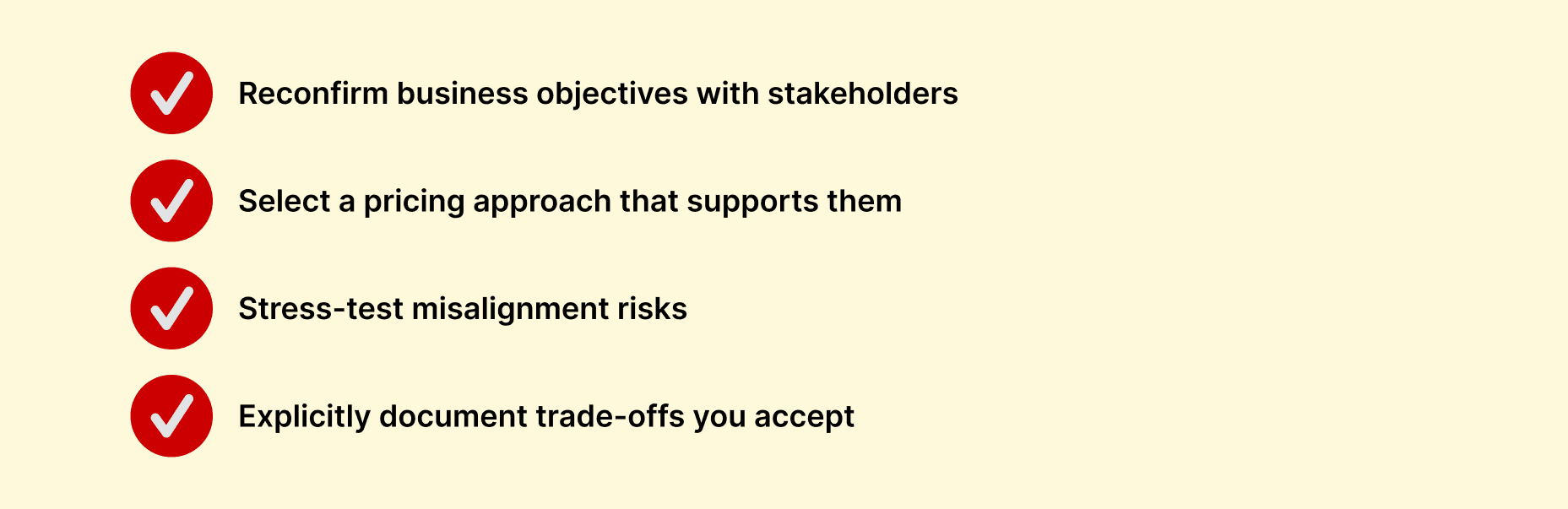
Checklist:
Step 4: Understand customers and willingness to pay
This is where pricing becomes real.
Different customers value different outcomes. Pricing that ignores this leaves money on the table or scares away the wrong people.
You need to understand:
Who your real customer segments are
What problem they are hiring your product to solve
Which elements of value matter most to them
How sensitive they are to price changes
This does not require perfect data. Interviews, surveys, deal reviews, and controlled experiments often reveal more than complex models.
The output of this step is not a precise price. It is confidence in relative value across segments.
Checklist
Define customer segments clearly
Map value drivers per segment
Validate assumptions qualitatively and quantitatively
Identify elasticity differences
Step 5: Choose a pricing model that fits behavior
“How much” you charge is only half the story. “How” you charge can matter even more.
A good pricing model:
Matches how customers perceive value
Scales with usage or outcomes where appropriate
Is simple enough to explain and defend
Encourages the right behavior
Common models include flat fees, per-user pricing, bundles, feature-based tiers, or usage-based pricing. Each has advantages and failure modes.
Avoid overengineering. Complexity almost always backfires at scale.
Checklist
Shortlist viable pricing models
Evaluate operational complexity
Validate with real customer feedback
Select and document the model clearly
Step 6: Design price communication deliberately
Customers do not react to prices objectively. They react to how prices are presented, explained, and justified.
This step is often neglected and then blamed on “price resistance”.
Strong price communication includes:
Clear articulation of value
Consistent framing across sales and marketing
Internal enablement to defend prices confidently
Price perception can destroy or reinforce positioning. Design it intentionally.
Checklist
Define core pricing narrative
Align sales and marketing messaging
Test comprehension and reactions
Remove unnecessary complexity
Step 7: Use discounts and promotions with discipline
Discounts are not inherently bad. Undisciplined discounts are.
Promotions should exist for specific reasons: acquisition, retention, behavior change, or risk reduction. They should not be default responses to discomfort.
Key principles:
Target discounts, don’t generalize them
Time-box promotions
Measure incremental impact
Protect long-term price integrity
If you cannot explain why a discount exists, it probably should not.
Checklist
Review historical discount effectiveness
Define rules and guardrails
Test selectively
Kill unprofitable promotions fast
Step 8: Put pricing governance in place
Pricing only works if the organization can execute it consistently.
Governance answers questions like:
Who owns pricing decisions?
Who can approve exceptions?
How often prices are reviewed
Which metrics matter most
Without governance, pricing decays quietly through exceptions, deals, and “special cases”.
This is where many otherwise strong pricing strategies fail.
Checklist
Clarify pricing ownership
Define approval thresholds
Align incentives
Track pricing KPIs consistently
Step 9: Treat pricing as a living system
Pricing is never done.
Markets change. Products evolve. Customers learn. Costs shift.
The best pricing teams revisit assumptions regularly, run controlled experiments, and adjust with intent rather than panic.
Build feedback loops. Schedule reviews. Keep pricing visible at leadership level.
Checklist
Set regular pricing reviews
Run structured experiments
Monitor external signals
Revisit fundamentals annually
Final thoughts
A strong pricing strategy is not about clever formulas or copying competitors. It is about clarity, discipline, and continuous learning.
When pricing aligns with strategy, customer value, and execution reality, it becomes a durable competitive advantage.
If you treat pricing as a system rather than a decision, it will compound over time.