How to Build OKRs That Truly Work: Framework and Template

Goals without clear measurement become wishful thinking. Objectives and Key Results (OKRs) transform vague aspirations into concrete outcomes that drive performance across your organization. Built on methodologies from Intel and Google, this framework promotes transparency, accountability, and alignment. Discover the seven-block system for building OKRs that truly work—from defining clear objectives to learning from each cycle.
Goals without a clear measurement system often become wishful thinking rather than achievable targets. Too many organizations set ambitious objectives only to watch them fade into the background noise of daily operations, forgotten until the next annual review. The difference between companies that achieve breakthrough results and those that merely survive often comes down to one thing: a systematic approach to goal-setting and execution.
Objectives and Key Results (OKRs) transform vague aspirations into concrete, measurable outcomes that drive performance at every level of your organization.
Drawing on methodologies pioneered at Intel and Google, and refined by thousands of organizations worldwide, this guide will walk you through building OKRs that genuinely work. You'll learn not just what OKRs are, but how to implement them effectively, avoid common pitfalls, and create a framework that propels your organization toward its most ambitious goals.
Why Build OKRs?
In today's rapidly evolving business environment, organizations face unprecedented complexity in aligning teams, measuring progress, and maintaining focus. OKRs solve these challenges by providing a framework that promotes transparency, accountability, and alignment. Unlike traditional goal-setting methods that cascade rigid targets from the top down, OKRs encourage collaboration between leadership and teams, ensuring that everyone understands not just what they're working toward, but why it matters.
The OKR methodology has proven effective for organizations ranging from 40-person startups to enterprises with over 140,000 employees. Companies like Google, LinkedIn, and Intel have used OKRs to achieve extraordinary growth, maintain strategic focus, and foster cultures of innovation and transparency.
OKR Framework
To build OKRs that truly work, you need a structured approach that goes beyond simply writing objectives and metrics. The OKR Framework consists of seven essential building blocks:
Define Clear Objectives:
Establish qualitative, inspirational goals that describe what you want to achieve. Objectives should be ambitious yet achievable, providing direction and motivation.
Create Measurable Key Results:
Quantify success with 2-5 specific, measurable outcomes per objective. Key results answer "how will we know we've achieved this objective?" with tangible metrics.
Establish the Right Cadence:
Determine your OKR cycle length—typically quarterly for tactical goals and annually for strategic priorities. The right rhythm keeps teams focused without causing burnout.
Align Across All Levels:
Ensure company, team, and individual OKRs connect and support each other. Alignment creates coherence and prevents siloed efforts that don't contribute to organizational success.
Score and Grade Your OKRs:
Implement a consistent scoring system (typically 0.0 to 1.0) to evaluate progress objectively. Scoring provides transparency and accountability while informing future goal-setting.
Conduct Regular Check-Ins:
Establish weekly or bi-weekly reviews to track progress, identify blockers, and maintain momentum. Regular check-ins prevent the "set it and forget it" syndrome.
Learn and Iterate: Use each OKR cycle as a learning opportunity. Reflect on what worked, what didn't, and how to improve your process for the next cycle.
This seven-block framework ensures your OKR implementation is comprehensive, sustainable, and genuinely transformative rather than just another management fad that fades after a few months.
Step-by-Step Guide: How to Build Your OKR Framework
Now let's dive into each of the seven components in detail. For each element, we'll discuss what you need to know, key questions to answer, common pitfalls to avoid, and indicators of success.
Define Clear Objectives
What It Is
Objectives are the qualitative, inspirational statements that describe what you want to achieve. They provide direction and motivation, answering the fundamental question: "Where do we want to go?" An effective objective is ambitious enough to inspire your team, concrete enough to provide direction, and memorable enough that people can recall it without checking their notes.
For example, "Become the most customer-centric company in our industry" is far more compelling than "Improve customer satisfaction metrics." The first objective paints a vision that teams can rally behind; the second merely describes a task.
How to Do It
Start by ensuring your objectives are actionable, time-bound, and ambitious. Use straightforward language that eliminates ambiguity and resonates emotionally with your team. Avoid corporate jargon or vague statements that could mean different things to different people.
Each objective should follow these principles:
Qualitative, not quantitative: Objectives describe a desired state or outcome, not a specific number. Save the numbers for your key results.
Inspirational: Great objectives motivate people to stretch beyond their comfort zone. They should excite rather than discourage.
Time-bound: While the specific deadline lives in your key results, objectives should have an implied timeframe (typically aligned with your OKR cycle).
Aligned with strategy: Every objective should connect clearly to your organization's broader mission and strategic priorities.
Start with 3-5 objectives maximum per OKR cycle. More than this dilutes focus and spreads resources too thin. Remember, OKRs are about prioritization as much as goal-setting—choosing what not to do is as important as choosing what to pursue.
Common Pitfalls
Setting too many objectives: Organizations often create 10+ objectives, believing more goals equal more progress. In reality, this guarantees mediocrity across all fronts. Limit yourself to 3-5 objectives that will make the biggest impact.
Being too vague: "Improve our business" tells no one anything actionable. "Launch in three new markets with localized products" provides clear direction.
Confusing objectives with key results: If your objective includes a number ("Increase revenue by 20%"), it's actually a key result masquerading as an objective. Objectives should be qualitative; key results quantitative.
Making them too easy: If you're certain you'll achieve every objective, they're not ambitious enough. OKRs should stretch your capabilities.
Tools & Frameworks
While there's no single "objective formula," many successful OKR practitioners use templates like:
"We will [action verb] [what you want to achieve] so that [impact or why it matters]"
For example: "We will revolutionize our onboarding experience so that new customers achieve their first success within 24 hours."
Consider using OKR software with built-in templates and AI assistance to help craft well-structured objectives.
Key Questions to Answer
What are the 3-5 most important outcomes we must achieve this quarter/year?
Does this objective inspire and motivate our team?
Is it clear enough that anyone in the organization could understand it?
Does it align with our broader company strategy and mission?
If we achieve this objective, will it create meaningful impact for our business?
Signs of Success
You know you've crafted excellent objectives when team members can recite them from memory, get excited discussing them, and immediately understand how their daily work connects to achieving them. In practical terms, a well-written objective should pass the "hallway test"—if you stop someone in the hallway and ask about the team's objectives, they should be able to articulate them clearly and explain why they matter.
B. Create Measurable Key Results
What It Is
Key results are the quantitative metrics that measure progress toward your objective. They answer "how will we know we're making progress?" with specific, measurable milestones. While objectives inspire, key results ground that inspiration in reality through concrete numbers.
Each objective should have 2-5 key results—enough to comprehensively measure success, but not so many that you lose focus. Key results must always include a metric (a number, percentage, or dollar amount) and typically follow a "from X to Y" structure that shows where you're starting and where you aim to finish.
How to Do It
The most effective key results follow a clear formula:
[Verb of change] + [Metric] + from [Starting point] to [Target] + by [Deadline]
For example:
"Increase monthly recurring revenue from $500K to $750K by Q4 2026"
"Reduce customer churn rate from 8% to 4% by end of Q2"
"Grow monthly active users from 50,000 to 100,000 by June 30"
When crafting key results, ensure they are:
Outcome-focused, not activity-focused: "Launch 5 new features" measures output; "Increase user engagement time from 12 to 20 minutes per session" measures outcome. Key results should describe the impact of your work, not the work itself.
Measurable and verifiable: Anyone on the team should be able to objectively assess progress without debate. Avoid words like "improve," "enhance," or "strengthen" without accompanying metrics.
Ambitious yet realistic: Key results should require a stretch but remain within the realm of possibility. Google famously aims for a 0.7 score on average—achieving about 70% of your target indicates appropriately ambitious goals.
Time-bound: Every key result needs a clear deadline, typically aligned with your OKR cycle end date.
Common Pitfalls
Treating key results as a to-do list: "Complete customer survey" is a task, not a key result. Instead: "Achieve an NPS score of 50 or higher based on 1,000 customer responses."
Using vague qualifiers: Avoid subjective terms like "significantly," "substantially," or "better." Use specific numbers.
Setting too many key results: More than 5 key results per objective typically indicates you're trying to measure too much or haven't identified the truly critical metrics.
Confusing key results with initiatives: Key results are outcomes you want to achieve; initiatives are the projects or activities you'll undertake to achieve them. "Launch new mobile app" is an initiative; "Achieve 100,000 app downloads with a 4.5+ star rating" is a key result.
Tools & Frameworks
Many organizations use SMART criteria adapted for OKRs: key results should be Specific, Measurable, Achievable (though stretch goals are encouraged), Relevant, and Time-bound.
OKR software platforms often provide libraries of pre-built key result templates categorized by function (sales, marketing, product, HR) that you can customize for your needs.
Key Questions to Answer
What specific metrics will prove we've achieved this objective?
Can we objectively measure and verify progress on this key result?
Does this key result measure an outcome (impact) or just an output (activity)?
Is the target ambitious enough to drive innovation, yet realistic enough to maintain team motivation?
Do we have the data and tools to track this metric throughout the cycle?
Signs of Success
Excellent key results create clarity and eliminate ambiguity about success. If team members debate whether a key result has been achieved, it wasn't specific enough. Great key results also drive the right behaviors—teams should be able to identify specific initiatives and projects that will move the needle on each key result.
C. Establish the Right Cadence
What It Is
OKR cadence refers to the rhythm or frequency with which you set, review, and reset your objectives and key results. The right cadence creates a predictable cycle of planning, execution, and reflection that keeps teams aligned without becoming overwhelming.
Most organizations use a dual-cadence approach: annual OKRs for strategic, long-term objectives paired with quarterly OKRs for tactical execution. This combination provides both the stability of long-term vision and the agility of short-term adaptation.
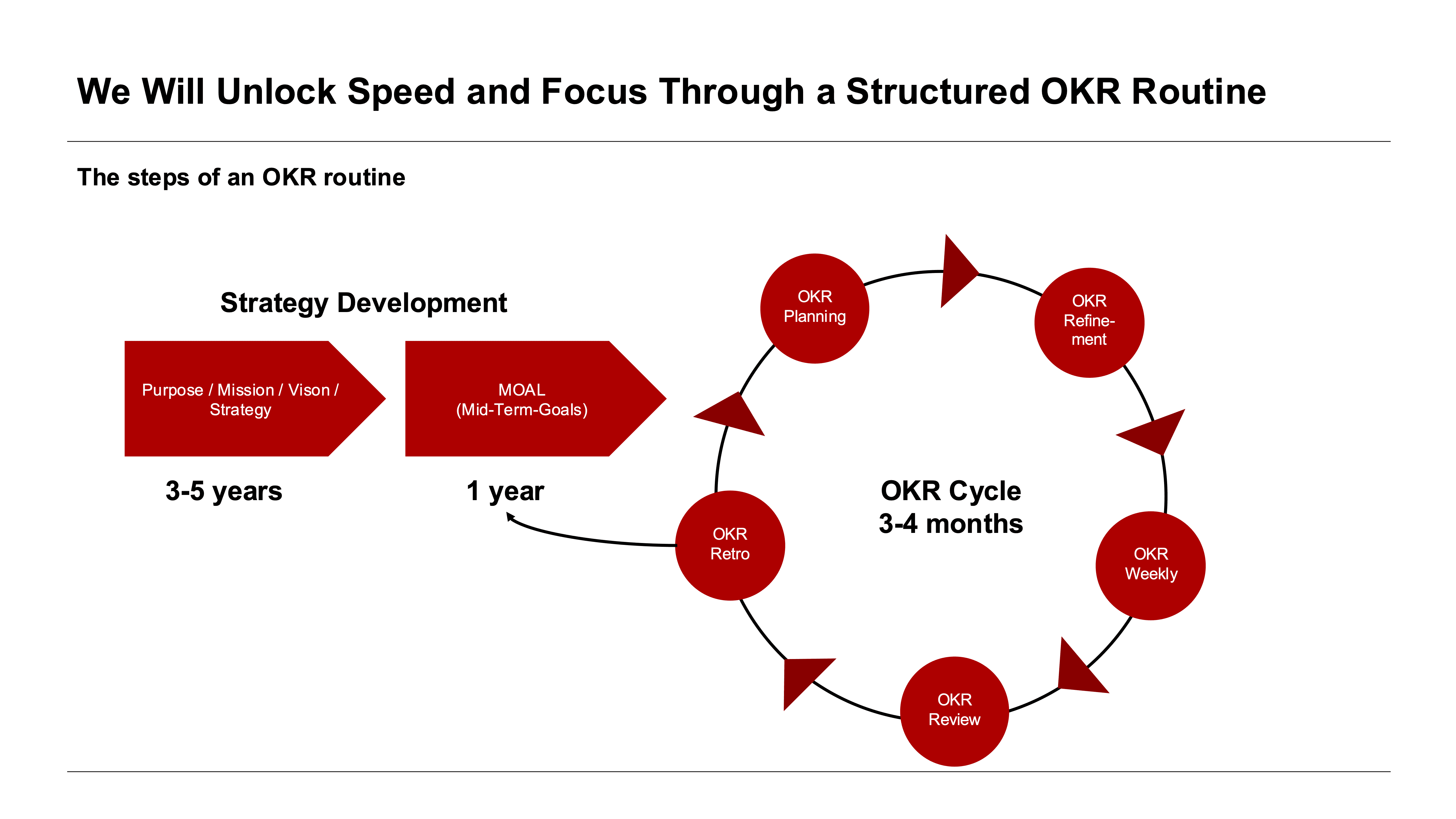
The OKR routine: The OKR routine slides and guidance are available in the OKR operationalization template & toolbox.
How to Do It
Choose your OKR cycle length:
For tactical goals (team and individual level): Quarterly cycles (90 days) work best for most organizations. This timeframe is long enough to achieve meaningful progress but short enough to adapt to changing circumstances and maintain urgency.
For strategic goals (company level): Annual cycles provide the horizon needed for ambitious, transformative objectives while quarterly OKRs break these down into achievable milestones.
For fast-moving startups: Some organizations use 6-week or monthly cycles when operating in highly dynamic environments where waiting a quarter to evaluate success is too long.
Establish check-in frequency:
Regardless of your OKR cycle length, implement regular check-ins:
Weekly check-ins (15-30 minutes): Quick team meetings to review key result progress, identify blockers, and adjust tactics.
Monthly reviews (1-2 hours): Deeper analysis of progress, discussion of strategic implications, and evaluation of whether initiatives are working.
Quarterly reviews (half-day): Comprehensive assessment of OKR achievement, lessons learned, and planning for the next cycle.
Common Pitfalls
Setting cadences too short: Monthly or weekly OKR cycles often overwhelm teams with constant planning rather than execution. Teams feel rushed and quality suffers.
Setting cadences too long: Annual cycles for all OKRs can cause goals to feel stale and teams to lose focus. Regular reviews become essential.
Using the same cadence for all goals: Strategic and tactical goals need different rhythms. Customize cadence based on goal type and organizational needs.
Skipping check-ins: Without regular reviews, OKRs become "set and forget," losing their power to drive continuous improvement.
Tools & Frameworks
Use this simple framework to determine your cadence:
Goal Type | OKR Cycle Length | Check-In Frequency |
|---|---|---|
Tactical (Team/Individual) | Quarterly | Weekly/Bi-weekly |
Strategic (Company) | Annual | Quarterly reviews |
Highly Dynamic (Startups) | 6-week or Monthly | Weekly |
Most OKR software platforms support multiple cadences and automate check-in reminders.
Key Questions to Answer
What timeline makes sense given our industry's pace of change?
Can we meaningfully measure progress and achieve results within this timeframe?
How often do we need to review OKRs to stay aligned without creating meeting fatigue?
Should different teams or departments use different cadences based on their work nature?
Signs of Success
The right cadence creates a sustainable rhythm. Teams should feel that OKR cycles are long enough to accomplish meaningful work but short enough to maintain urgency. Check-ins should feel valuable rather than burdensome, providing genuine opportunities to course-correct and celebrate progress.
D. Align Across All Levels
What It Is
OKR alignment ensures that objectives and key results at the company, department, team, and individual levels connect and support each other, creating coherence throughout the organization. When properly aligned, every person can trace how their daily work contributes to the company's most important goals.
Unlike traditional cascading (where goals flow rigidly from top to bottom), effective OKR alignment involves collaboration and transparency. Leadership sets the strategic direction, but teams have autonomy in determining how they'll contribute to those objectives.
How to Do It
Start with company-level OKRs: The executive team establishes 3-5 company objectives that define what success looks like for the organization this cycle. These should connect directly to the company's strategic plan and mission.
Create team OKRs through collaborative planning: Rather than dictating team OKRs, ask teams to identify how they can best contribute to company objectives. This bottom-up input ensures buy-in and leverages the expertise of those closest to the work.
Teams should answer: "How can our work in this cycle move the needle on one or more company objectives?"
Establish individual OKRs: Team members create their own OKRs that support their team's objectives. Not every individual OKR needs to directly link to a company objective—some may focus on professional development or operational excellence—but the majority should clearly contribute to team and organizational goals.
Visualize the alignment: Use an OKR tree or alignment map to show how objectives connect across levels. For example:
Company Objective: Become the market leader in sustainable packaging
Department Objective (Sales): Grow revenue from new markets from 0% to 10%
Team Objective (Outbound Sales): Increase pipeline 5% month-over-month
Individual Objective (Sales Rep): Engage all qualified leads weekly and form 1 new partnership per month
Notice how each level supports the one above it while giving teams and individuals autonomy in defining their approach.
Cross-check alignment: Review OKRs both top-down and bottom-up to ensure coherence. Ask: "If we achieve all our team and individual OKRs, will we accomplish our company objectives?"
Common Pitfalls
Cascading vs. aligning: Rigidly cascading every company key result down as team objectives creates a controlling, top-down culture that ignores valuable ground-level insights. Instead, cascade objectives while allowing teams to define their own key results.
Failing to create alignment: When teams set OKRs in isolation without considering company priorities, you end up with fragmented efforts that don't contribute to organizational success.
Over-aligning: Not every team or individual OKR needs to directly link to a company objective. Some OKRs can address operational excellence, team development, or departmental priorities.
Lack of transparency: If people can't see others' OKRs, alignment becomes impossible. Implement a system where all OKRs are visible across the organization.
Tools & Frameworks
The 50/50 rule: Many successful OKR implementations use a hybrid approach where 50% of OKRs come from top-down direction and 50% emerge from bottom-up input.
Alignment mapping: Create visual representations showing how OKRs connect across levels. Most OKR software platforms include alignment visualization features.
Key Questions to Answer
How does each team OKR contribute to at least one company objective?
Have we involved teams in defining how they'll contribute rather than dictating their approach?
Can every individual explain how their work connects to the organization's priorities?
Are OKRs transparent enough that people can see and understand others' goals?
Have we avoided over-cascading, allowing teams appropriate autonomy?
Signs of Success
Perfect alignment manifests when team members can articulate the company's objectives, explain how their team contributes, and describe their personal role in that contribution—all without checking documentation. Another indicator: cross-functional dependencies and conflicts decrease because teams understand how their work fits into the larger puzzle.
E. Score and Grade Your OKRs
What It Is
OKR scoring provides an objective way to measure achievement at the end of each cycle. Unlike traditional goal systems where anything less than 100% is considered failure, OKR scoring embraces ambitious goal-setting by recognizing that achieving 70-80% of a stretch goal represents excellent performance.
Scoring transforms subjective opinions about success into objective evaluations, creating accountability and providing data to inform future goal-setting.
How to Do It
Use the 0.0 to 1.0 scale: The most common OKR grading system, popularized by Google, scores each key result on a scale from 0.0 (no progress) to 1.0 (complete achievement).
The scale typically maps to three zones:
0.7 to 1.0 (Green): Strong progress or achievement. You set ambitious goals and delivered significant results.
0.4 to 0.6 (Yellow): Moderate progress. You made headway but fell short of your target, indicating either the goal was too ambitious or execution fell short.
0.0 to 0.3 (Red): Minimal progress. Significant obstacles prevented achievement or the goal was unrealistic.
Score individual key results first: Each key result receives its own score based on actual achievement versus target. For example, if your key result was "Increase MRR from $500K to $1M" and you reached $850K, your score would be: (850-500)/(1000-500) = 0.7.
Calculate the objective score: Average the scores of all key results under that objective. If your three key results scored 0.7, 0.8, and 0.6, your objective score is (0.7+0.8+0.6)/3 = 0.7.
Define scoring criteria upfront: At the beginning of each cycle, clarify what different score levels mean for each key result. This prevents debates about achievement and ensures consistent evaluation.
Common Pitfalls
Consistently scoring 1.0: If teams regularly achieve perfect scores, goals aren't ambitious enough. Adjust targets upward to maintain the stretch that drives innovation.
Penalizing lower scores: If compensation or performance reviews are directly tied to OKR scores, teams will sandbag with conservative goals. OKRs should be aspirational, and a 0.7 score should be celebrated as strong achievement.
Making scoring too complex: Some organizations create elaborate weighted scoring systems that require spreadsheets to calculate. Keep it simple so anyone can quickly assess progress.
Skipping the scoring process: Without objective scoring, OKR evaluations become subjective debates rather than learning opportunities.
Tools & Frameworks
Google's grading philosophy: Aim for an average score of 0.7 across your OKRs. Consistently scoring 1.0 means you're not pushing hard enough; consistently scoring below 0.4 means you're setting unrealistic expectations.
Alternative scoring systems:
Binary scoring (0 or 1): Simply achieved or not achieved—useful for clear-cut deliverables.
Percentage-based: Convert the 0.0-1.0 scale to percentages (0-100%) for easier understanding.
Color-coding: Use red, yellow, and green visual indicators for quick status assessment.
Most OKR software automatically calculates scores as you update progress, removing manual computation.
Key Questions to Answer
Did we achieve the key result as defined at the cycle's start?
If we didn't fully achieve it, how much progress did we make?
Was the target appropriately ambitious, or should we adjust our goal-setting approach?
What prevented us from achieving higher scores?
What enabled our successes that we should replicate?
Signs of Success
Effective OKR scoring creates a culture where teams view a 0.7 as success, freely discuss obstacles without fear of punishment, and use scores to improve future goal-setting rather than as report cards. Organizations with mature OKR scoring systems show consistent average scores in the 0.6-0.8 range, indicating appropriately ambitious goal-setting.
F. Conduct Regular Check-Ins
What It Is
Regular check-ins are structured meetings where teams review OKR progress, discuss obstacles, celebrate wins, and adjust tactics. Unlike traditional status updates, check-ins are forward-looking conversations focused on "What needs to happen to keep us on track?" rather than backward-looking reports.
The check-in rhythm creates accountability, maintains momentum, and prevents the common "set and forget" pattern where goals are established in January and forgotten until December.
How to Do It
Establish multiple check-in levels:
Weekly team check-ins (15-30 minutes):
Quick review of each key result's current status
Identification of blockers requiring immediate attention
Assignment of actions for the coming week
Celebration of small wins to maintain motivation
Monthly progress reviews (1-2 hours):
Deeper analysis of trends and patterns in the data
Discussion of whether current initiatives are working or need adjustment
Resource reallocation if certain OKRs are off-track
Cross-team coordination on dependencies
Quarterly reflections (half-day or full-day):
Comprehensive scoring and evaluation of the cycle's OKRs
Lessons learned: what worked, what didn't, and why
Planning for the next OKR cycle incorporating insights gained
Celebration of achievements and recognition of efforts
Structure your check-ins effectively:
Use a consistent agenda so check-ins become efficient rather than meandering:
Review each OKR's current score/progress
Discuss confidence level: Are we on track, at risk, or off-track?
Identify top 2-3 blockers preventing progress
Decide on actions and owners for the next period
Share quick wins and lessons learned
Update progress transparently: Between check-ins, update key result progress in your OKR tracking system so everyone can see real-time status. This transparency enables proactive problem-solving.
Common Pitfalls
Skipping check-ins when "too busy": Ironically, the times teams skip check-ins due to workload are exactly when they need them most to ensure effort aligns with priorities.
Treating check-ins as status reports: If check-ins become one-way updates without discussion, problem-solving, or course correction, they lose their value. Make them collaborative conversations.
No follow-through on identified blockers: If the same obstacles appear in check-ins week after week without resolution, the check-in process is failing.
Infrequent reviews: Checking OKRs only at the end of the quarter provides no opportunity to course-correct.
Tools & Frameworks
The confidence score method: In addition to actual progress, teams rate their confidence in achieving each key result by cycle-end using a three-level system:
On track (green): High confidence in achieving the target
At risk (yellow): Concerns about hitting the target without intervention
Off track (red): Unlikely to achieve the target without significant changes
This forward-looking assessment helps surface problems before they become crises.
Weekly check-in templates: Many OKR software platforms provide structured check-in workflows with automated reminders and progress tracking.
Key Questions to Answer
What progress have we made on each key result since the last check-in?
What's blocking us from making faster progress?
Are our current initiatives working, or do we need to try different approaches?
What resources or support do we need to get back on track?
What should we celebrate or learn from this week?
Signs of Success
Effective check-ins feel productive rather than bureaucratic. Teams should leave check-ins with clarity on priorities, concrete actions assigned, and obstacles being actively addressed. Over time, check-ins become habitual parts of team rhythm rather than forced exercises, and OKR achievement rates improve as teams catch and correct issues early.
G. Learn and Iterate
What It Is
The final—and perhaps most important—element of effective OKRs is treating each cycle as a learning opportunity. The end of every OKR cycle should include structured reflection on what worked, what didn't, and how to improve the process itself.
Organizations that view OKRs as a static framework quickly see diminishing returns. Those that continuously refine their approach based on experience build increasingly effective goal-setting systems.
How to Do It
Conduct a comprehensive cycle review: At the end of each OKR cycle, hold a retrospective meeting addressing:
Achievement analysis:
Which OKRs did we achieve and why?
Which OKRs did we miss and why?
Were our targets appropriately ambitious?
Did we focus on the right objectives?
Process evaluation:
Was our check-in cadence effective?
Did we have the right number of objectives (too many, too few)?
Were our key results truly measuring outcomes or just activities?
Did alignment work—could people see how their work contributed?
Cultural assessment:
Are OKRs helping us focus or adding bureaucracy?
Is there transparency in progress and challenges?
Are teams comfortable with ambitious goals or sandbagging with easy targets?
How can leadership better support the OKR process?
Document learnings: Capture insights in a shared document so the organizational memory persists beyond the current team. Note specific changes you'll make in the next cycle.
Start small and scale: If you're new to OKRs, begin with a pilot group before rolling out organization-wide. Use the pilot to identify what works in your specific culture and context.
Adjust your approach: Based on learnings, modify aspects of your OKR practice:
Adjust the number of objectives if focus is spreading too thin
Change check-in frequency if reviews feel too frequent or infrequent
Refine how you write objectives if they're consistently too vague or too tactical
Improve alignment processes if teams feel disconnected from company goals
Common Pitfalls
Treating OKRs as rigid: Rigidly following "the OKR way" without adapting to your organization's needs leads to resistance and eventual abandonment. OKRs are a framework, not a religion.
Expecting perfection immediately: Organizations often expect OKRs to transform everything in one quarter. In reality, mastering OKRs takes 3-4 cycles.
Not celebrating learning from "failures": If teams feel punished for ambitious goals they didn't fully achieve, they'll revert to conservative targets. Celebrate the learning, not just the achievement.
Changing too much between cycles: While iteration is important, changing your entire OKR process every quarter creates confusion. Make incremental improvements.
Tools & Frameworks
The OKR maturity model: Track your organization's evolution through typical OKR adoption stages:
Stage 1 (Cycles 1-2): Learning the basics, experiencing initial confusion, making foundational mistakes
Stage 2 (Cycles 3-4): Developing rhythm, improving objective/key result quality, seeing initial benefits
Stage 3 (Cycles 5+): OKRs become embedded in culture, consistent strong execution, measurable business impact
Understanding where you are in this journey helps set appropriate expectations.
Retrospective frameworks: Use structured retrospective methods like "Start, Stop, Continue" or "What went well, What didn't, What to try next" to guide your reflection.
Key Questions to Answer
What specific improvements will we make to our OKR process next cycle?
What patterns do we see in which types of objectives we achieve vs. miss?
Are OKRs providing value proportional to the time we invest in them?
How can we make OKRs feel more natural and less bureaucratic?
What support or resources would help teams succeed with OKRs?
Signs of Success
Organizations with mature OKR practices show consistent improvement in key metrics over multiple cycles: higher OKR achievement rates, better strategic alignment, increased employee engagement, and stronger business results. Teams view OKR retrospectives as valuable rather than perfunctory, and refinements to the process come from the teams themselves rather than being mandated from above.
OKR Templates
Building effective OKRs is half the challenge; communicating them clearly and tracking them consistently is the other half. Templates and tools streamline this process, allowing teams to focus on execution rather than administration.
Frameworkery offers professionally designed OKR templates that incorporate best practices from leading organizations:
A. Comprehensive OKR Planning Template
A complete template containing structured worksheets for annual and quarterly OKR planning, including sections for alignment mapping, progress tracking, and retrospectives. This template includes:
Company, department, team, and individual OKR worksheets
Alignment visualization tools to map connections between levels
Scoring and grading calculators
Check-in meeting agendas and tracking sheets
Quarterly retrospective frameworks
This template is ideal for:
Organizations implementing OKRs for the first time
Teams wanting a structured approach to OKR planning
Companies transitioning from other goal-setting frameworks
Mid-sized to large organizations needing multi-level alignment
B. Simple OKR Execution Template
A streamlined template focusing on tracking and execution, perfect for teams that have already established their OKR process and need efficient monitoring tools. This template includes:
Clean OKR tracking sheets with progress indicators
Weekly check-in templates
Confidence scoring systems
Initiative tracking linked to key results
Simple dashboard views for quick status assessment
This template is ideal for:
Startups and small teams wanting minimal overhead
Experienced OKR practitioners focused on execution
Fast-moving environments requiring agility
Teams using OKR software but needing supplementary planning tools
Further Reading
If you'd like to dig deeper into related frameworks and techniques, these additional resources will help:
Strategic Planning Frameworks – connecting OKRs to broader strategy
Performance Management Templates – integrating OKRs with reviews and development
Team Alignment Worksheets – fostering collaboration across functions
Progress Tracking Dashboards – visualizing OKR status for stakeholders
Ready to Transform Your Goal-Setting?
Download our comprehensive OKR template and start building objectives that truly drive results. Whether you're a Fortune 500 company or a startup, our battle-tested frameworks will help you implement OKRs that work from day one.
The difference between organizations that thrive and those that stagnate often comes down to one simple factor: intentional, systematic goal-setting aligned across every level. OKRs give you that system. With the framework and guidance in this article, you have everything you need to build OKRs that don't just exist on paper—OKRs that genuinely transform how your organization thinks, works, and achieves its most ambitious vision.