What Is a Product Strategy?

A product strategy is what turns product work into progress. It clarifies who you are building for, what problem truly matters, and how your product can win over time. Without it, teams ship features and stay busy, but struggle to build real advantage. In this article, you’ll learn what a product strategy actually is, why it matters, and how to create one that guides decisions, aligns teams, and stands up in practice.
A lot of teams build products the way people pack for a trip they did not plan. They start moving, buy things along the way, and hope the destination becomes obvious once they get close.
Sometimes it works. More often, the team ends up with a backlog full of features, a roadmap that changes weekly, and a product that struggles to explain why it exists.
A product strategy is what prevents you from basing yourself on luck alone. It is the logic that connects your market, your customers, your product bets, and your business outcomes. It gives your team direction and gives leadership a way to make trade-offs without turning every decision into a debate.
This guide breaks down what product strategy actually is, what it should include, and a step-by-step method to create one.
What is a product strategy?
A product strategy is a set of choices that explains:
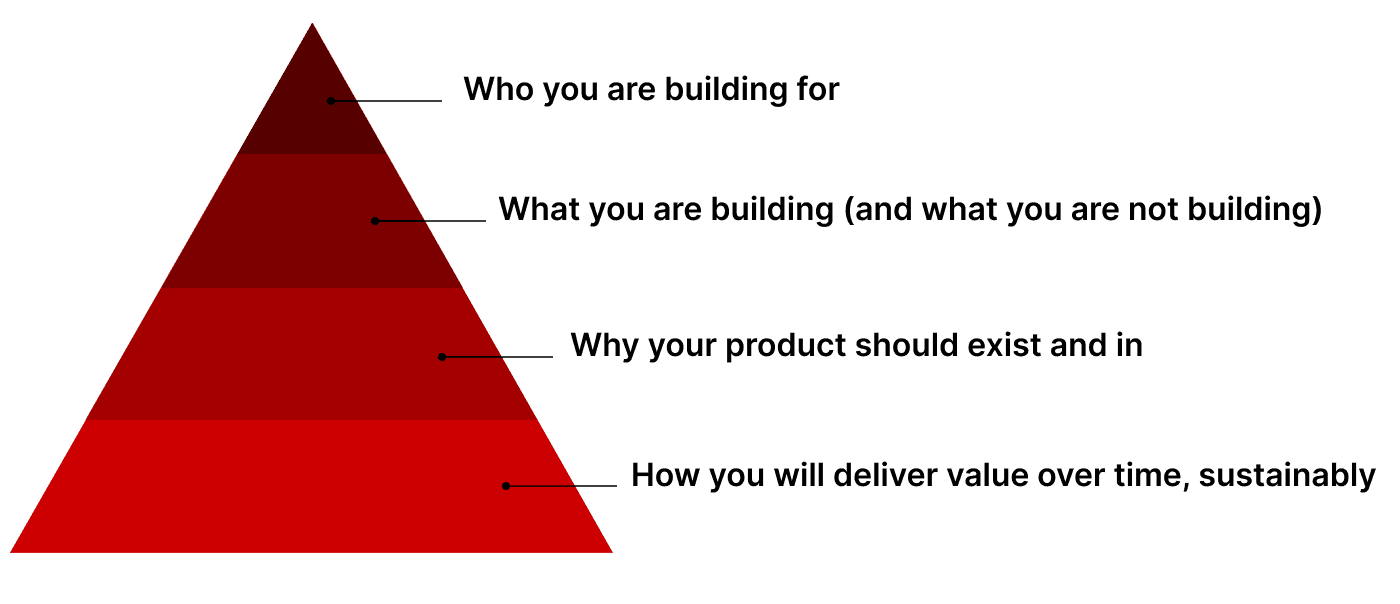
It is not a feature list. It is not a roadmap. It is not a pitch deck.
A good product strategy should help someone answer, in plain language:
Why this product, for these users, in this market, right now?
What advantage do we believe we can build?
What sequence of bets gets us there without burning the company down?
Product strategy can exist at two levels:
Portfolio strategy: how your product lines fit together, who each serves, and how you allocate resources across them
Product-level strategy: how a specific product wins and evolves over time
The point of product strategy is to create a clear value proposition that is differentiated enough to earn adoption and durable enough to support a business.
Product strategy vs product vision
Teams often mix these up, so here’s a simple way to separate them:
Product vision is the future state you want to create. It is inspirational and directional.
Product strategy is the reasoning and set of choices that gets you there.
If vision answers “where are we going?”, strategy answers:
who we serve
how we win
what we prioritize
what we stop doing
how we measure progress
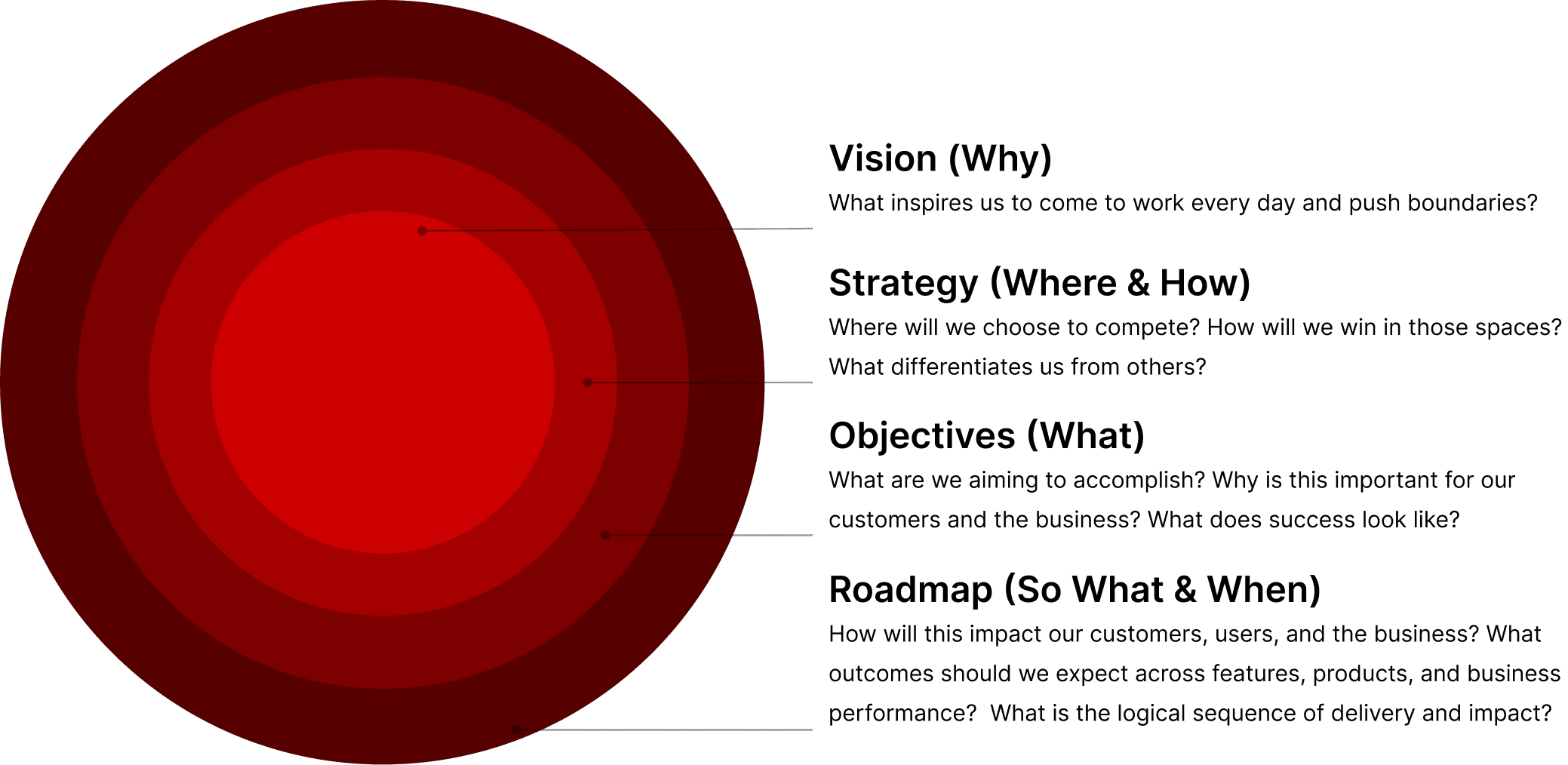
❗️ A vision can fit on a sticky note. A strategy usually needs a few pages.
Why product strategy matters
Product strategy is useful because it makes teams faster, not slower. It reduces thrash. It gives you a shared language for prioritization. And it keeps the product from being shaped only by the loudest voice in the room. You can find the core benefits bellow:
It creates clarity when things get messy
Most product work is ambiguous. Strategy gives a stable reference point when:
stakeholders push conflicting requests
customer feedback points in different directions
new competitors change the narrative
It protects your resources
Time and focus are the real constraints. Without a strategy, teams build too much, too broadly, and too soon.
A strategy helps you choose the few bets that matter and say no to the rest.
It improves differentiation
If you do not define how you are different, the market will decide for you, usually by comparing you on price.
Strategy forces you to answer: what will we be known for?
It increases the chance of product market fit
Product market fit is not magic. It is what happens when:
a real segment has a real problem
your solution is meaningfully better for that segment
adoption, retention, and willingness to pay follow
Many products fail because they are built around internal assumptions, not external demand.
It improves decision-making with real signals
Selling a product teaches you things that internal discussions cannot:
what customers actually value
what they ignore
what they will pay for
which promises land, and which do not
Strategy should evolve based on those signals, not on hunches.
It aligns teams and reduces politics
A strategy clarifies responsibilities and expected outcomes across product, design, engineering, marketing, sales, and customer success.
When the story is shared, teams collaborate. When it is not, teams negotiate.
Key elements of a product strategy framework
You can structure product strategy in many ways, but the most effective strategies include the same building blocks.
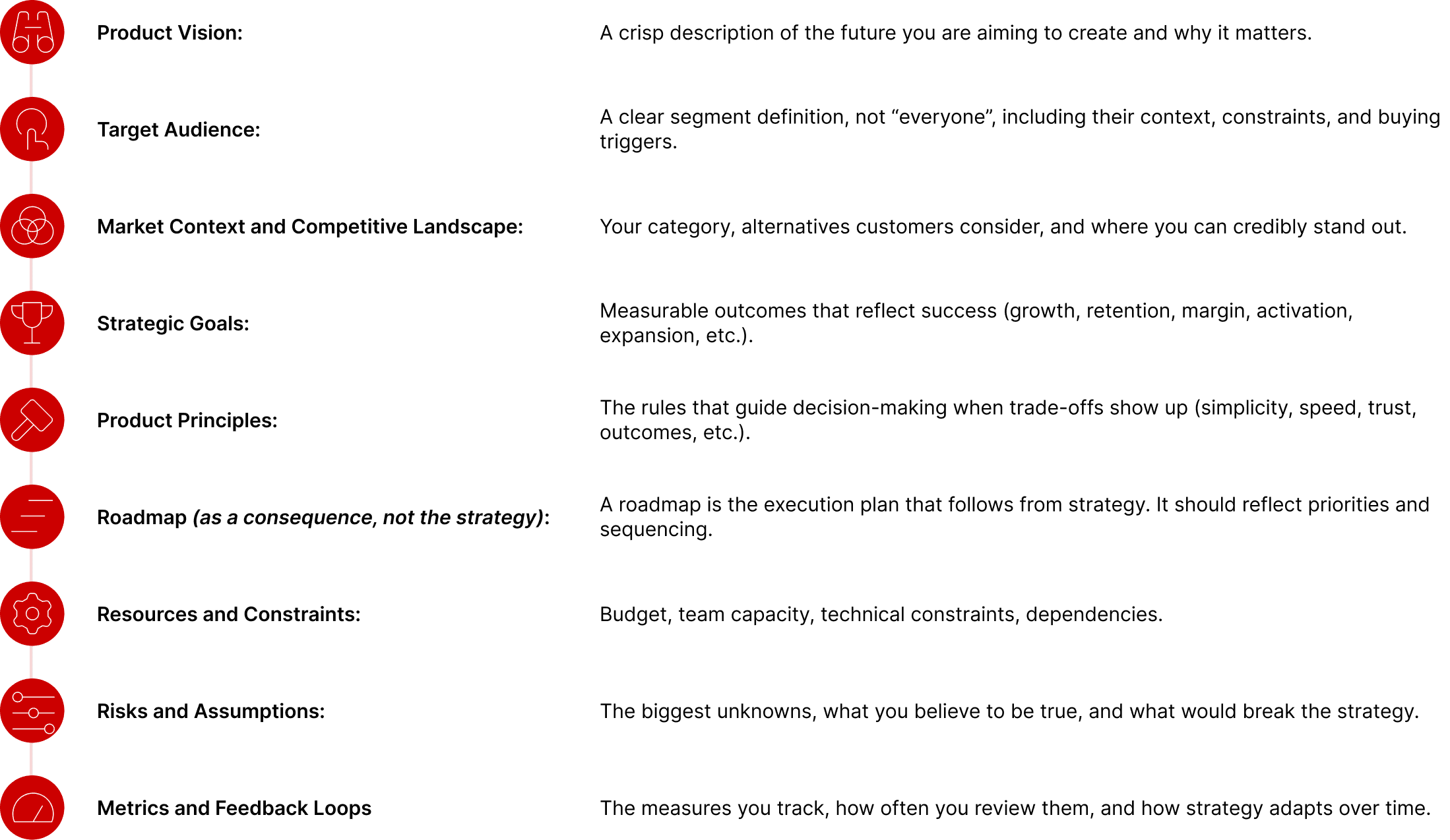
Five common product strategy “angles” (types)
Most product strategies lean heavily toward one dominant lever. Many products combine more than one, but it helps to be explicit.
Cost-led strategy: Win through affordability and operational efficiency. Requires strong cost control and clear scope.
Quality-led strategy: Win through superior craft, performance, reliability, or design. Usually requires focus and strong positioning.
Service-led strategy: Win through customer experience, support, onboarding, and responsiveness. Often works in categories where trust and switching costs matter.
Differentiation-led strategy: Win through a unique capability that alternatives cannot match. The key is defensibility and relevance, not novelty.
Focus-led strategy: Win by serving a narrower segment extremely well. This is often the fastest path to traction for early-stage products.
How to create a product strategy step by step
Below is a practical process you can run with a team. It is designed to be usable whether you are early-stage or scaling.
Step 1: Define your target customer with precision
Start by choosing a segment you can actually describe and reach. Avoid “anyone who wants X”.
Helpful inputs:
interviews
support tickets
sales calls
usage data
churn reasons
Output: 1–3 primary segments with clear characteristics and needs.
Step 2: Get crisp on the problem you are solving
Write the problem in a way that would make sense to a customer. Validate it. The trap to avoid is building a solution that is exciting internally but irrelevant externally.
Output: a problem statement + why it matters + what happens if it is not solved.
Step 3: Write the product vision in one page
A strong vision is directional, not a list of tasks.
It includes:
the future you want to create
who benefits
what changes for them
why your company is uniquely positioned to deliver it
Step 4: Describe current state vs target condition
Be honest about where you are today. Define what “good” looks like in a concrete way. This helps avoid vague strategy statements that are impossible to execute.
Output: current reality, target experience, and the gap you must close.
Step 5: Define product principles
Principles are decision tools. They reduce debate.
Examples:
“Speed over completeness”
“Trust before growth”
“Self-serve first, human support second”
“Simple pricing beats perfect pricing”
Output: 3–6 principles that you can apply to roadmap decisions.
Step 6: Choose strategic bets and sequence them
This is where strategy becomes real. Pick the few bets that will move the needle most. Then sequence them based on dependencies and learning.
Output: a set of strategic initiatives with rationale, not just features.
Step 7: Build a roadmap that reflects the strategy
Now translate bets into delivery. Roadmaps can be time-based or theme-based. The important part is that they show:
what comes first and why
what you are deprioritizing
what you will measure
Step 8: Define success metrics and guardrails
Pick metrics that reflect the strategy.
Examples:
activation rate
retention and cohort health
expansion
time to value
gross margin contribution
NPS or qualitative satisfaction signals
Also define guardrails, for example “growth cannot come at the cost of churn” or “margin cannot drop below X”.
Step 9: Execute, learn, and update
A strategy that never changes is stubborn. A strategy that changes every month is unstable.
Set a cadence:
monthly signal reviews
quarterly strategy checkpoints
annual deeper reset if needed
Product strategy FAQ
What are the steps to develop a product strategy?
A practical sequence is:
Identify target audience
Understand and validate the problem
Establish product vision
Define current state and target condition
Outline product principles
Choose strategic bets and build roadmap
Define success metrics
Execute and iterate
What are five types of product strategies?
Common approaches include:
cost-led
quality-led
service-led
differentiation-led
focus-led
What should a product strategy include?
A strong product strategy typically includes:
vision and positioning
target audience and segments
market context and competitors
strategic goals
principles and trade-offs
strategic initiatives and roadmap direction
resources and constraints
risks and key assumptions
metrics and review cadence
How often should product strategy be reviewed?
A good default:
review metrics monthly
revisit strategy quarterly
refresh more deeply once per year
If you operate in a fast-moving market, you may need tighter iteration, but continuity still matters.