The Manager Facing Uncertainty: Deciding Fast While Keeping the Course

Every manager eventually meets the same wall. The market shifts, the data is incomplete, and a decision is due before the picture clears. Speed and direction start to feel like opposites. They are not. The real skill is learning to decide quickly without losing the thread that holds an organization together. This article walks through how to do exactly that, built around four levers every leader can pull: leadership, communication, psychological safety, and process.
A Situation Like So Many Others
Picture a mid-sized company, a leader in its field. Then the ground moves. New competitors, leaner and faster, reinvent the business model. New technologies change the way customers navigate the market. And in parallel, an economic downturn slowly shrinks the size of that market.
Nothing here is unusual. This is the ordinary texture of business life. What separates companies is not whether they face this moment, but how they respond to it.
The Ostrich Strategy
The first reaction is often denial dressed up as confidence. "It is temporary, the economy will bounce back, we are the leaders." The position feels protective, so leadership assumes it protects.
"Carry on, nothing to see here." On the surface only, because beneath it the panic is rising. Teams keep operating business as usual, since officially there is no problem. Some genuinely believe it. Others, usually the more senior people, do not. They understand the inaction, they see what is coming, and they cannot act on it. One by one, the best people start to leave. That last point is the tell. When your strongest performers quit before the crisis is even acknowledged, the denial has already cost you more than the downturn.
Business as Usual on a Bed of Panic
Denial does not stay still. It evolves into something more expensive. The company trims headcount step by step to defend profitability. Faced with the lack of impact, leadership reaches for big strategic bets, leaning on familiar, proven solutions because they feel safe.
The trouble is that these bets rest on so many assumptions that it becomes difficult, sometimes impossible, to understand why they succeed or fail. When a bet pays off, no one can reliably say why. When it fails, the lesson is just as murky. The organization spends heavily and learns nothing it can reuse.
Four Dimensions to Act On
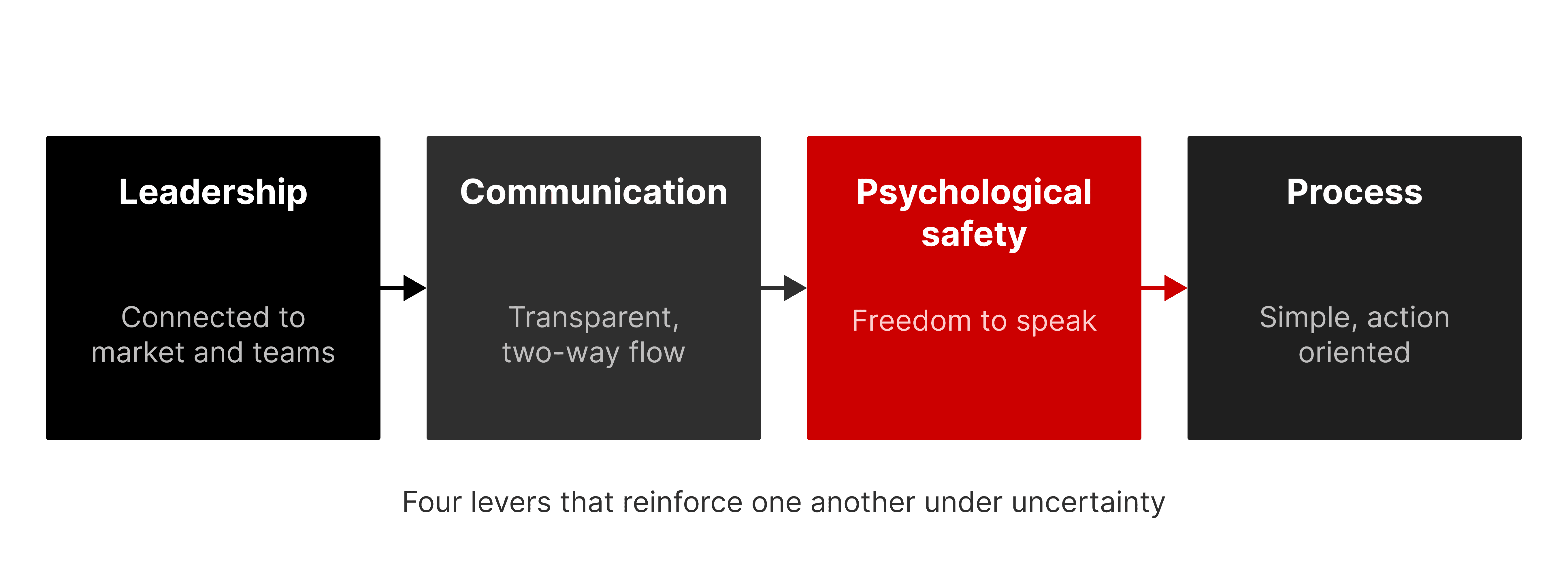
This single situation exposes four dimensions where a leader must act. They are not independent fixes. They reinforce one another, and weakness in one drains the others.
Leadership that stays connected to the market and to the teams, carrying a clear vision that orients priorities.
Communication built on transparent, consistent messages, with a smooth flow of information back up so the trajectory can be adjusted.
Psychological safety, the freedom to voice ideas and raise alarms, and the ability to initiate and experiment without fear.
Process that is simple and action-oriented, keeping teams aligned on objectives through an iterative, adaptable approach.
The rest of this article takes each one in turn.
Leadership Through the Prism of Uncertainty
Start by reframing what leadership means in this context. We live in an uncertain world, and uncertainty is precisely a situation where we lack information, which makes predictions hard and sometimes impossible. The sources are many: political, economic, environmental, technological. Uncertainty challenges our beliefs and mental models, and it cannot be avoided. You do not get to opt out of it.
Here is the reframe that changes everything: we are wired for it. Uncertainty creates an inner conflict, yes, but it also fuels agency, the power to act, which is what lets us develop opportunities in the first place. If everything were certain, everything would be predictable, and a fully predictable world is a poor place for innovation. More than that, human beings are exceptional at solving problems in groups, even in deeply uncertain settings. The discomfort and the capability come from the same source.
That is why co-creation sits at the heart of adaptive leadership. In a world saturated with information that is often incomplete, decisions rest on weak signals. Knowledge is scattered across teams. Those teams have to detect, interpret, escalate, and act on weak signals quickly, and effective management today runs on that collective intelligence. In an adaptive model, the leader becomes a facilitator of collective learning rather than the single source of answers.
This matters because of a common and costly error. Traditional leadership assumes the leader holds all the answers, which leads to a diagnostic mistake: an adaptive challenge gets treated as a technical problem. Known solutions are applied to new and complex situations, and the result is temporary fixes that never touch the root causes. The shift is away from command and control toward an adaptive approach centered on collective learning and co-construction. In periods of uncertainty, that is the more powerful stance. Leadership does not have every answer, but it can build the environment where the answers get found.
Communication: Trust in a World That Keeps Accelerating
Many leaders believe they protect their teams by keeping certain information to themselves. In the short term it feels more comfortable. In the long term it erodes trust. Teams can sense when something is unclear, and that dissonance breeds doubt.
The paradox is that saying "I do not yet know the details of how" can actually strengthen credibility. This is trusted transparency: information shared in a way that is clear, verifiable, and consistent. It does not mean telling everyone everything. It means showing lucidity and honesty, which opens the door to co-creation, because the team can and should help find the answers.
The negative case makes the cost concrete. A leader who hides information and does not clearly communicate progress or difficulties builds a culture where reality can no longer be spoken and solutions can no longer emerge, because action is blocked. The likely consequences stack up: information stops flowing upward, strategies become top-down and disconnected from the field, plans work or fail with no systemic logic to explain either outcome, and the organization is poorly prepared for change.
Trust, though, is not built mainly in big announcements. It is built in small repeated gestures and rituals. It helps to think about communication in three directions.
Top-down, when leadership communicates to teams: strategy updates and, above them, reminders or iterations of the mission and vision; company performance; outcomes of board meetings; key market information; and goals for the coming months and years.
Bottom-up, when teams communicate to middle and top management: progress on objectives, user feedback, and candid input on goals, priorities, and managerial decisions.
Transversal, between teams and departments: updates on initiatives within and across teams, and exchanges between middle managers and between leaders, both formal and informal.
Finally, leaders adapt communication to the audience. Executives want clear, concise messages. Experts prefer technical detail. The most effective method is layered communication: a headline that works for everyone, context available for those who want to understand more, and a deep dive for the specialists.

And it is not enough to send the right message, you have to make sure the message received is the one you sent. The Shannon and Weaver communication model from 1948 is worth revisiting here, because noise sits between every sender and every receiver.
Psychological Safety: The Ground That Makes Action Possible
Psychological safety is the shared belief within a team that anyone can take interpersonal risks, proposing ideas, asking questions, admitting mistakes, without fear of negative consequences. It is not the absence of disagreement. It is the capacity to show vulnerability, exchange openly, and learn together. Put simply: psychological safety equals the freedom to speak, plus learning from mistakes, plus constructive risk-taking.
The payoff is not soft. Teams with high psychological safety generate more creative ideas, take considered risks, and bring new products and services to market faster. They surface operational problems earlier through greater transparency, which lowers the chance of major failures. And the effect ripples across the whole performance picture: quality, safety, compliance, retention, turnover, reputation, attractiveness, and ultimately financial performance through the competitive advantage it creates.
Building that safe environment demands clarity, stability, and transparency. Protecting a team does not mean withholding information. It means being clear about what is going well, what is not, and what decisions are coming. Concretely, a psychologically safe environment means zero surprises in how the organization acts, no "everything is fine" followed by sudden layoffs. It means a stable frame in which teams can solve problems, and clear objectives that let the organization move forward. Those objectives bring us to the fourth lever.
Process: The Accelerator of Creativity
There is a stubborn myth that process kills creativity. The opposite is closer to the truth. Structure creates mastery, prevents chaos, and makes the state of flow easier to reach. Routine feeds creativity, and the great artists prove it. Beethoven counted out exactly sixty coffee beans for his morning cup. Agatha Christie wrote without a dedicated desk, working wherever she happened to be. Murakami wakes at four in the morning and writes for five to six hours. The point is not the specific ritual. The point is that ritual turns flashes of genius into reproducible output, and reproducibility is what an organization needs.
Process also reduces uncertainty directly. It guarantees consistent execution and, just as importantly, it supports the way you define, update, and align mission, vision, strategy, objectives, and priorities with the results the business expects. This is the chain that runs from the highest level of purpose down to the daily work.
Mission and vision are more important than ever here. Google remains the cleanest illustration. Its mission, to organize the world's information and make it universally accessible and useful, sits above its vision of providing access to the world's information in one click. The mission is the enduring reason to exist. The vision is the picture of where that reason points. Strategy and then goals and objectives flow from there.
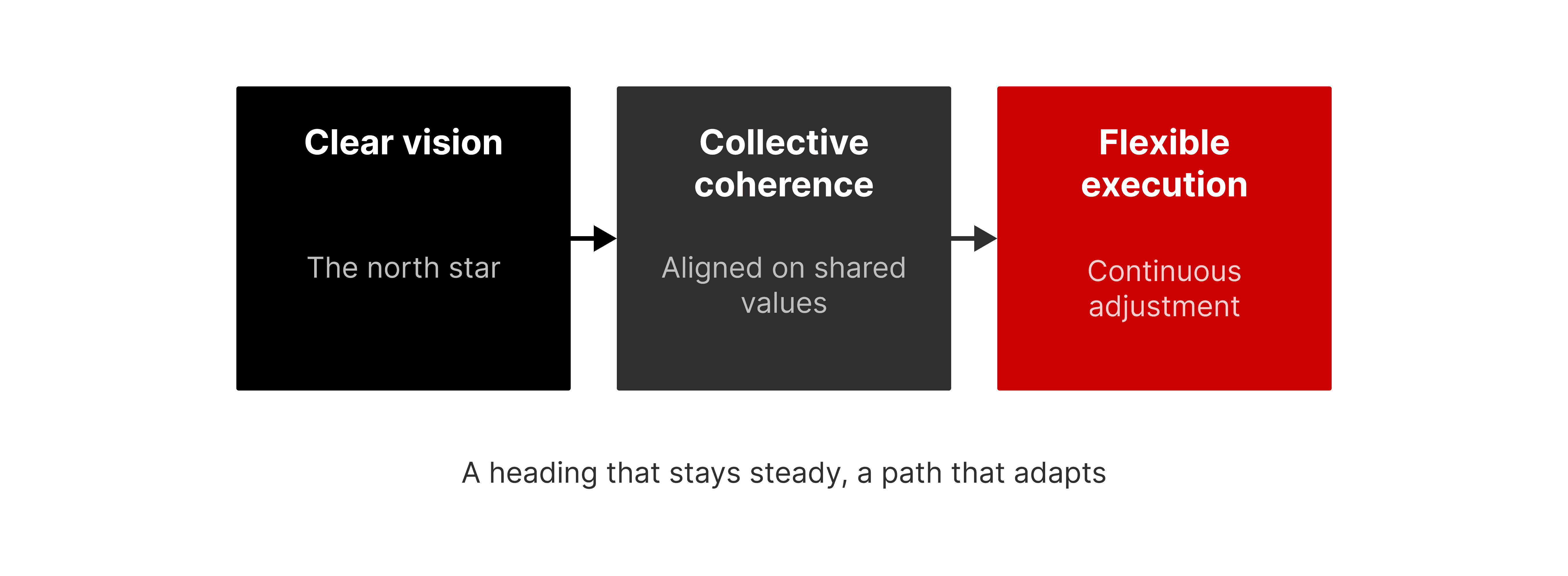
The core balance is between direction and adaptability. Research on strategic uncertainty shows that high-performing organizations maintain a strong, coherent vision while staying flexible in their actions and their strategic and tactical choices. The vision is the north star: coherence around shared ideas and values, a stable direction with continuous course corrections. It gives meaning without freezing action. It aligns people on values and shared purpose rather than a rigid plan, which is exactly what creates a stable frame for innovation. The heading stays steady. The path adapts.
To connect vision to execution, OKRs (Objectives and Key Results) are the practical instrument. The system aligns objectives with organizational priorities: managers define the what, teams determine the how. Use them when managers know what must be done and teams know how to achieve it. Organizational OKRs are set once a year, cascaded down through departments and teams, then steered in cycles of about three months with regular adjustments.
Keeping that chain aligned, from vision through to quarterly key results, is exactly what the Product Strategy Toolbox from Slidesfolder is designed to help you achieve.
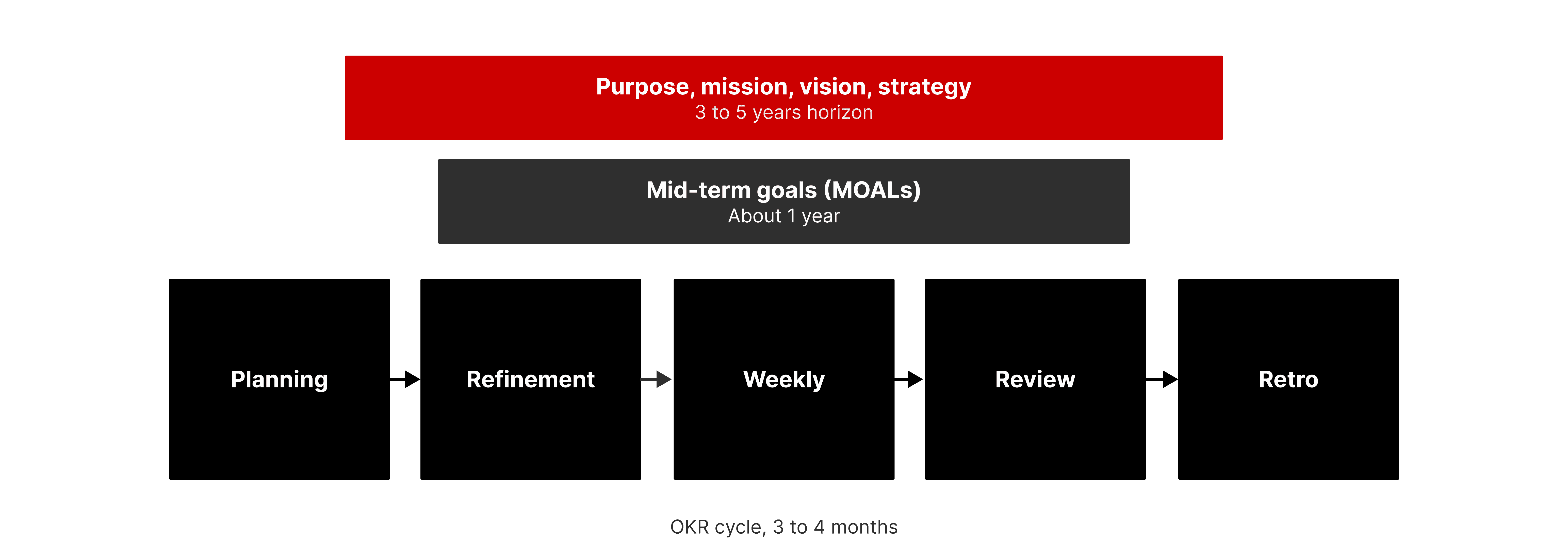
But OKRs are more than a framework. They are a rhythm, a set of rituals, a genuine dynamic of iteration. Purpose, mission, vision, and strategy sit at the top, developed over a three-to-five-year horizon. Below them sit mid-term goals (MOALs) on a roughly one-year horizon. And inside each three-to-four-month OKR cycle, a cadence repeats: planning, refinement, weekly check-ins, review, and a retrospective. The cadence is what keeps fast decisions tethered to the long-term course.
Iterative Innovation Instead of Big Bets
This brings the argument full circle, back to those big strategic bets from the start. The alternative is a culture of iterative innovation. Reduce approval delays for small tests and pilot projects. Encourage a safe-to-fail posture, testing with controlled risk rather than betting the company.
A genuine safe-to-fail experiment has five properties. There is a plausible rationale, so each test rests on a clear hypothesis. There are measurable results, so you know how to evaluate impact. The risk is limited, so failure stays contained and manageable. There is scalability, so success leads to wider deployment. And there is a recovery plan, so if it fails you know how to correct course or roll back.
Each of these experiments should ladder up to a clear strategic intent rather than floating on its own. Our piece on building a product strategy covers how to connect day-to-day experimentation to bigger picture.
Crucially, this is not only for tech. Experimentation lives in every department and every type of product. In technology, the familiar examples are smoke tests, user tests with mockups, A/B testing, and the minimum viable product. But the same logic applies to a pricing change tested in one region, a new onboarding flow tried with one customer segment, or a revised approval process piloted in a single team. The question to keep asking is simple: what other examples exist in your own organization?
In Conclusion: Back to Our Example
Return now to that mid-sized leader facing leaner competitors, shifting technology, and a shrinking market. The ostrich strategy and the bed of panic were never the only options. With leadership reframed as the facilitation of collective learning, communication built on trusted transparency, psychological safety that lets reality be spoken, and process that turns vision into an iterative rhythm, the same situation looks different. The decisions still have to be made fast, on incomplete information. But the course holds, because the four levers are pulling together rather than against each other.
Deciding fast and keeping the course was never a contradiction. It is a discipline, and it is one any leadership team can build.