









From Strategy to Results
Works in PowerPoint, Google Slides, and Keynote. Every key slide includes built-in guidance so you're never staring at a blank page.
What Will You Get
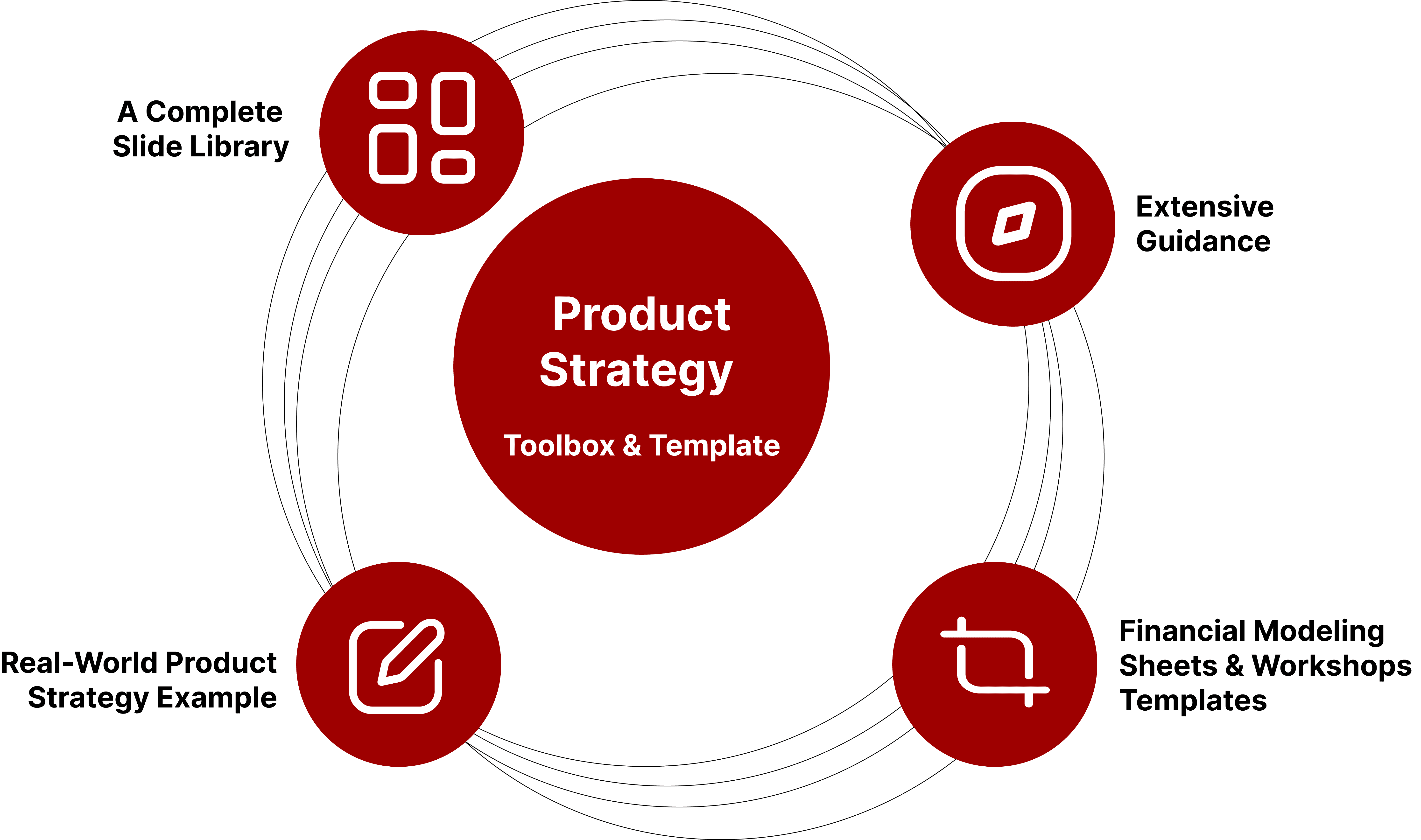
450+ Execution Slides Ready to Use
Swap our placeholder text with your data and present. We've mapped out the exact agenda you need: Mission & Vision → External Environment → Firm Capabilities → Strategy Definition → Strategic Goals → Change Management → Next Steps. No design degree required.


Calculation Sheets: Turn Your Strategy Into Numbers
Ready-to-use spreadsheets to ground your execution plan in reality. The market-sizing sheet walks through TAM/SAM/SOM step by step. The business case model outlines revenue potential from your sizing outputs. The OKR sheet tracks objectives and key results from company strategy down to team-level execution, with owners, deadlines, and progress scores in one view. All three are designed to feed directly into the slide templates.
Workshop Templates: Align Your Team in One Session
Facilitation-ready workshops with built-in guidance, starting with Mission & Vision alignment, a structured session that walks your leadership team through purpose, direction, and strategic priorities using silent-first exercises so every voice is heard before group discussion. Designed for a 2- to 3-hour session; adapt the prompts and timeboxes to your team's context.


Built-In Guidance: Learn While You Build
This is not just a template; it's a system that teaches you as you use it. Guidance is embedded directly on key slides - a Why, a What, and a "How to use this section" - so you always know what a slide is for before you fill it in. Whether you're a first-time strategy lead or a seasoned executive, the guidance helps you move faster and communicate sharper.
When to Use This Toolkit
Whether you're a seasoned executive or a first-time strategy lead, this presentation template adapts to your needs:
Turning an approved strategy into a concrete execution plan
Setting and cascading OKRs from company to team level
Prioritizing initiatives and building a roadmap leadership will actually commit to
Communicating a change, restructuring, or new direction across the organization
Building a data-backed business case to secure budget or headcount
The SlidesFolder Method

Frequently Asked Questions
General
How often do you refresh your templates?
In which formats do you deliver the templates?
Can I use your templates in Google Slides?
What templates and toolboxes are available on SlidesFolder?
Customization & Branding
My company already has strict brand guidelines. Can your templates match them?
Can I change colors, fonts, and logos in the templates?
I need a template that I can’t find in your catalog. Can you create it?
Purchasing & Access
Can I buy several templates together and get a discount?
How do I receive my templates after purchase?
What should I do if I don’t receive the download email or the link doesn’t work?
Product Differences & Value
What makes your templates different from standard PowerPoint templates online?
Do your templates include guidance on how to use them?
Support and Other Questions
Can I get help editing or adapting a template?
What if I have a question that isn’t covered here?
What is business execution?
Business execution is the set of processes, cascaded goals, and operating rhythms that turn a strategy into daily work and measurable results. It is not the strategy itself, a roadmap, or a single planning workshop. It covers how strategic pillars cascade into team-level OKRs, how governance and rituals keep teams aligned, how roadmaps and metrics track progress, and how leaders review and adjust based on what the data shows. Good execution closes the gap between what a company says it will do and what actually happens across teams. The Business Execution Toolkit provides the frameworks, OKR cascade, business case models, and financial templates to build that operating system from scratch.
What is the difference between strategy and execution?
Strategy and execution are two different disciplines that most companies treat as one. Strategy is the set of choices about where to compete, which customers to serve, and how to win against alternatives. Execution is everything that happens after those choices are made: cascading goals into OKRs, assigning ownership, sequencing initiatives, and building the rituals and metrics that keep teams accountable to the plan. Put simply, strategy sets the direction, and execution determines whether the company actually gets there. Most strategy work stops at the direction-setting stage. The Business Execution Toolkit picks up from there and gives you the frameworks to operationalize it.
What makes business execution effective?
Effective business execution turns a strategy into consistent action across every team, not just a plan sitting in a slide deck. In practice, that means strategic pillars are visibly cascaded into team and individual OKRs, governance and review rituals are scheduled and followed, roadmaps show what is being built and why, and metrics make it clear whether the strategy is working. Strong execution also builds in a regular cadence to revisit and adjust the plan as new information comes in, rather than treating strategy as a once-a-year exercise. The toolkit structures all of this into 450+ editable slides, so teams have both the discipline and the artifacts to run it consistently.
What is inside the Business Execution Toolkit?
The toolkit includes 450+ slides organized into 9 sections, covering how to build a strategy, cascading OKRs, business model design, business case construction, and financial planning, plus case studies showing the frameworks applied end to end. It comes with several calculation sheets (financial modeling, market sizing, and OKR planning) and a facilitation-ready workshop templates, along with embedded guidance on building a strategy, writing effective slides, and structuring a compelling storyline.
Who is the Business Execution Toolkit for?
It is built for founders, operators, and business leaders who need to move a strategy from planning into action: cascading it into team goals, building the business case for it, modeling the financials, and tracking whether it is actually working. The embedded guidance supports leaders running their first structured execution cycle as well as experienced operators who want a consistent set of templates across the organization.
